Kaitaku: a step into the unknown. The story of a team born inside Gonka
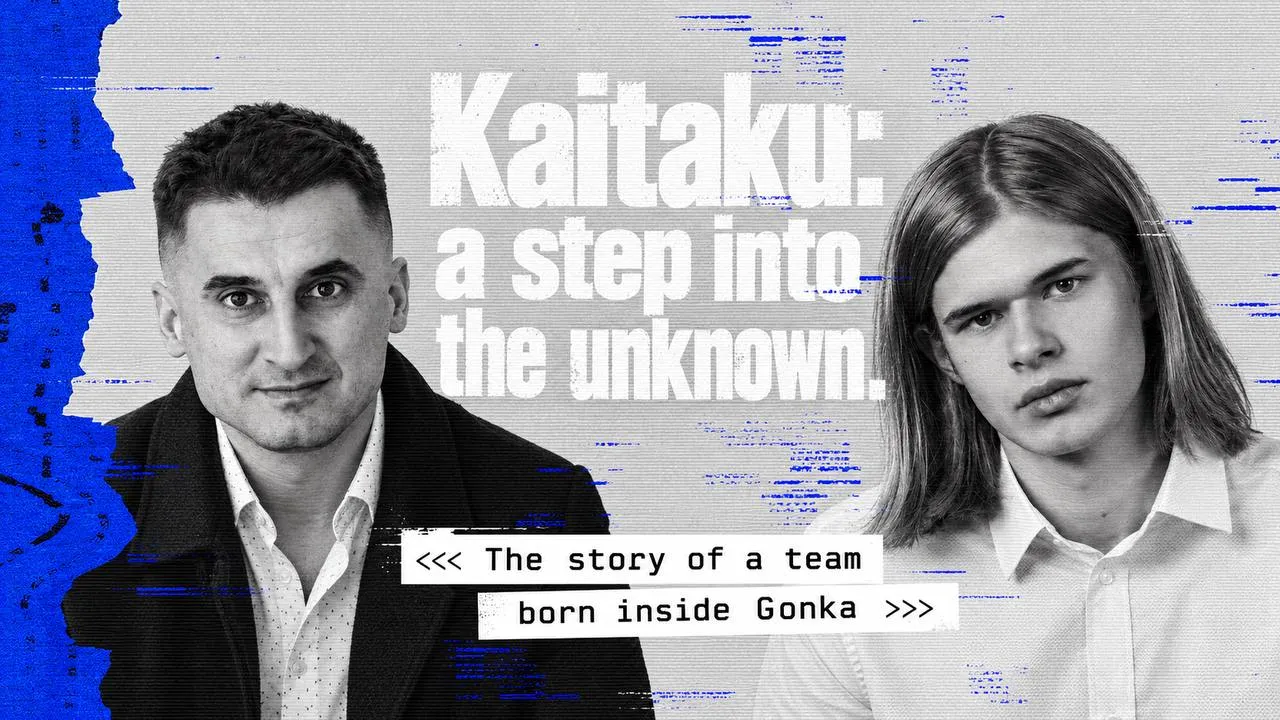
Mykola Baichak (left) and Pasha Solovsky from the Kaitaku team. Collage: Varvara Laba.
The story of the team — from early mining nodes and a chance meeting on Discord to AI model integration, work on Decode PoC, and independent development inside Gonka.
It started with an inspiring idea: what if access to artificial intelligence did not depend on a few large corporations, and computing power could be brought together in a network distributed around the world?
This idea, discussed in one of the Liberman brothers’ interviews, caught the attention of experienced developer Mykola Baichak, indie entrepreneur Pasha Solovsky, and investor Oleksiy Sitnichenko. They discovered Gonka independently and decided to join the project as independent miners. Later, they combined their technical experience, investment, and shared interest in the project to create the Kaitaku team.
Today, Kaitaku has gone far beyond mining. The team has worked on several important AI models that were added to Gonka. They helped prepare them for integration and later joined the work on Decode PoC — one of the most important current upgrades, which should make the network much more efficient.
In an interview with Gonka Community Blog, Mykola and Pasha explained how a random meeting on Discord turned into a business partnership, and how an unexpected crisis opened the door for them to start working on the protocol itself.
Before Gonka came along
— Let’s start with your background. What did you do before Gonka, and why did you decide to join the project?
Mykola: I had about ten years of experience in software development. I worked in Kyiv, mostly for outsourcing companies.
One interesting project was an automated trading system. We needed to make it rebalance a stock portfolio automatically. There was some very complex financial math and Monte Carlo modeling. We worked on it for about a year, but in the end the project did not take off.
After that, I joined a Volvo project where we were developing autonomous driving technology. I spent most of the next few years there and grew as a data engineer. Building autonomous driving systems is a huge task. You have a fleet of cars with many cameras, lidars, and radars. All this data is recorded, processed, and passed through a long chain of teams.
Our team prepared datasets and metadata for model training. For example, another team might say: we do not just need data from bridges at night, we specifically need bridges at night in rainy weather. We had to find, collect, and prepare this data. It was not easy at all. I got very good experience with big data, architecture design, and building data pipelines.
And then Gonka happened.
I watched the Libermans’ interview with Sokolovsky. I had already seen an earlier interview with them, and I really liked the idea of looking at a person as a project that you should invest in. It even changed the way I thought about myself a little.
Then they presented Gonka. By that time, I already understood how important AI tools were becoming in almost all of my work. And I did not want someone else to decide the terms of my access to AI or how much I had to pay for it. There should be an alternative. Gonka offered one. I liked that.
— Pasha, what was your path?
Pasha: I don’t have a ten-year career story like that. I was always building my own projects, mostly small ones.
The biggest ones were trading bots. Not for stocks, but for crypto tokens, memecoins, and NFTs. It was my small business. I was already using AI while building those bots.
Then I came across Sokolovsky’s interview with the Libermans on YouTube. Gonka really interested me, so I started looking into it. I launched my first node on an RTX 4090. I think it was in December, or maybe even earlier. At that time, the network did not support the RTX 5090 yet. I calculated that if I could get one running, it could be very profitable.
In the end, I found a way to run it using my own code. It was one of the first 5090s on the network. At that time, GNK was worth around two to two and a half dollars, while our cost per GNK was around 15 cents.
— That sounds good even by today’s standards.
Pasha: Even by today’s standards, yes! But of course, you cannot get that kind of return from these GPUs anymore.
Between stability and adventure
— How did you find each other and decide to work together?
Mykola: Pasha was the first person who replied to me on Discord. At the time, I was looking for somewhere to host my first servers.
I first rented a server on Hetzner, and he told me I could get one cheaper through the auction. Then he told me where I could find GPUs at a good price. I started renting more and more GPUs. One day Pasha asked me: “Hey, are you the guy taking all the GPUs there so there is nothing left for me?”
I said: “Yes, that’s me. I’ll leave some for you.” Then I thought: why not bring Pasha into our team? He was clearly a smart and capable guy.
Pasha: Yes, I was interested in the community and was looking at what different people were doing. I found Kolya on Discord. There were a lot of messages there, but for some reason I decided to write to him. That is how it all started.
— And how did Alexey become part of the story?
Mykola: Through Pasha, I got into a chat where people could ask the Libermans questions directly. That is where Alexey found me.
He wanted to hire someone. But things were already good for me: I lived in Portugal, had a job, earned a salary, and had enough money to live. I told him: “I’m not looking for a job. But I am interested in investment.” He said: “Really? Let’s talk.”
We had a call, and he offered to invest a very significant amount. I think it was a Friday, around the middle of the day. I remember that after the call I could not do anything else. I had a decision to make. On one side, I had a stable job and everything was fine. On the other side, I could go on an adventure. A very interesting one.
In the end, I took one month of unpaid leave from work. Everyone there got worried: “Did someone get sick? What happened?” But I started setting up hardware for Gonka. Alexey sent the first money for mining, and I thought: “Wow. Now I can finally build everything I dreamed about.”
We did not have enough resources. He had resources, but he needed people who could do the work. Most importantly, all of us were excited about it. Alexey has a lot of business experience, and normally other people do the calculations for him. But this time he was sitting in Excel and calculating things himself. We sat down together, ran the numbers, talked, and that is how it started.
The first crisis became an opportunity
— At first, were you planning to focus only on mining?
Mykola: Yes, at first it was just mining. But I immediately saw opportunities to make it more efficient. The project would grow, and it would need more and more resources — GPUs and other hardware.
We needed a way to bring in as much hardware as possible from around the world and use it efficiently, while keeping the team small and avoiding high administrative costs.
At some point, we realized that when we improved efficiency for ourselves, we also improved mining efficiency for the whole network because we were part of that system.
— Is that what pushed you toward protocol development?
Mykola: The first crisis pushed us there. To mine, we needed to find enough good hardware at a good price and get it running. A lot of people had problems finding hardware at the time. We found very good equipment, and Alexey helped a lot.
I was still connecting the first machines when he was already saying that we needed to go and sign a contract with a data center. I had not even thought about that yet. By the time we had our first working version of the system, the hardware was already ready. We launched many RTX PRO 6000 GPUs.
At that time, they were very efficient because the Qwen 32B model fit entirely into the memory of a single GPU. That gave us very good efficiency.
Pasha: But at that point, the model itself was not so important because PoC — Proof of Compute — was running on a small model. Our problem started when the network moved to the new PoC.
Our GPUs did not have NVLink. They were connected through regular PCIe slots. When we moved to PoC v2, there was only one Qwen model with 235 billion parameters, and we needed four GPUs to run it. We started hitting the bandwidth limit of the connection between the cards.
But that came later. At first, we discovered that our GPUs were not supported by the new update at all.
Mykola: Imagine this: we had a contract with a data center, everything was paid for, and then the new PoC came out.
We were not mining at all. We were just paying rent and earning nothing. This continued for almost a week. We started thinking about what we could do and contacted Gleb Morgachev, one of Gonka’s protocol co-creators. They sent us the first prototype of software that could work with these GPUs. But it did not work yet. It took us several days to get it running properly.
That is basically how we first connected with the protocol development team. A crisis forced us to contact Gleb, and that became our first real connection.
From mining to development
— How did that first contact turn into real work on Gonka?
Pasha: We wanted to launch a new model because our efficiency on Qwen had dropped a lot. Our GPUs were limited by bandwidth.
Also, Qwen itself was not the best model. We started suggesting that the network should add another model. In the end, we agreed on GPT-OSS 120B. It looked like a good option both for us and for the network.
We were asked to test it. We ran all the tests, but in the end we decided not to add that model to the network. At the same time, we started testing Kimi. Kimi was added to the network. That is how we accidentally started working with Gleb’s team.
— Maybe this is not the most modest question, but what do you see as Kaitaku’s most important contribution to Gonka so far?
Mykola: I need to think… I would say our work on preparing the latest models that entered the network. There are now users of DeepSeek-V4-Flash and GLM-5.3-Flash. We worked on these models and built a way to add new models so that the process could become repeatable.
Before that, when a new vLLM image arrived, it had to be connected directly with Gonka’s code. Everything was mixed together: you took a vLLM branch and added Gonka code on top of it.
We decided to separate these parts. Now there is a minimal image that we change as little as possible, so it can be updated quickly. Gonka code is connected next to it almost like a plugin — everything needed for verification, PoC, and other functions.
We developed and tested this approach, first used it ourselves, and then gave it to the network. Now it has become part of the common codebase. I think that is very important.
— When did development become more important for you than mining itself?
Mykola: It happened this summer. At some point, we realized it made more sense to invest more into development.
Maybe it happened because during the summer we hardly did any mining work. We might check the servers once every couple of days, but most of our energy went into development.
We realized that the system itself needed to improve. We still constantly balance where to put our effort — development or mining. But development needs investment, otherwise nothing will move forward.
Why profitable mining can hurt the network
— What else have you been working on, and why is there so much attention on Decode PoC now?
Mykola: It is a very large piece of work. Our part is already done, but the core team still needs to test it.
I think Decode PoC will seriously change the incentives for miners and hosts when it is introduced. Right now, there is a mismatch: you can optimize PoC performance while actual inference becomes less important. We need model optimization to be connected to real inference performance.
— Can you give an example?
Mykola: Pasha and I launched a MiniMax image. Of course, we also tried to optimize everything as much as possible from the start.
Then, literally one day after we released the image, Pasha messaged me saying he had found a flag that improved the PoC result by about 40%, but made inference performance worse. We looked at it and thought: “So what do we do now?”
I think this became one of the things that pushed the network toward a new PoC. Again, a solution came out of a crisis.
After that, we put a lot of effort into helping the network move to another evaluation system. Let me put it this way: we knew about this optimization and reported it to the core team immediately. At the same time, we watched to see who else on the network would discover it first.
Eventually, one person did. We tried to talk to him, but it was clear that it is difficult to convince someone not to use an optimization when they can see a large difference in profitability.
So it was only a matter of time. Then miners started using the optimization very quickly, and the network moved into a new stable state.
— Pasha, how should Decode PoC change the situation? What will users notice?
Pasha: First of all, inference quality should improve. The problem today is that the current PoC is based on prefill, so people try to make prefill as fast as possible.
As a result, model images that perform very well in PoC can be much worse at decode. Output token generation can be two or three times slower than it could be. This also makes the network slower.
When Decode PoC is introduced, it will also take output tokens into account and give them the proper weight. This should push people to optimize their instances for real inference performance if they want to earn more rewards.
— So hosts will have a stronger incentive to provide fast inference, instead of simply showing good benchmark results?
Mykola: Exactly. And there is one important point here: the Decode PoC algorithm itself was designed by Ilya Slavutin from the Axel-T team.
At first, we were supposed to test it, just as we test other models. But when you start testing something like this, you slowly become involved in development too.
In the end, we did more development work than testing because the two are closely connected.
— Is Decode PoC also connected to future dynamic pricing?
Mykola: Yes. They should work together.
Dynamic pricing should help distribute compute more evenly between models, while Decode PoC should reduce problems in how their performance is measured.
For example, there are very well-optimized MiniMax models today. Decode PoC should make their weight better reflect the actual inference they provide, rather than just their benchmark result.
The cost of independent development
— Work at this level requires resources. How do you finance experiments and plan your work?
Mykola: Recently, we have been working a lot. I think even more than I used to work at companies. You work because you are excited about it. You stay awake at night because something needs to be done. Weekends stop mattering.
Once I went on vacation — my wife basically forced me to take a week off. But even there, I was walking around with my phone and writing code. Today you can use Claude remotely, so you can keep working from almost anywhere.
I did not expect this project to pull me in so much. And that is a good thing. When developers really care about what they are building, the quality of work is completely different. One hour can sometimes be as productive as several normal working hours.
But of course, there are costs too. I later checked all the billing myself. We spent about $9,600 on testing alone. And those were only the costs I could clearly confirm. Sometimes we had a machine that had dropped out of an epoch, and we could use it for experiments. I did not count things like that at all.
Pasha: And it is important to understand that we did not just rent a server for a month and let it mine on Gonka when we were not using it.
We looked for the cheapest spot servers we could find to keep the costs as low as possible. If we had used on-demand hardware, the costs would have been much higher.
— How far ahead can you plan your work?
Mykola: What did it look like in practice? Summer ended, and we understood that we needed to decide what to do next.
The token price was low, and mining was not bringing in much money. So the question was: how do we plan? Do we have enough resources?
We constantly felt like our planning horizon was only one month. But if you want to build more complex things, you would like to have at least three months.
That is why I really liked Gleb’s idea of submitting a proposal to fund his team for a full year. When the community sees that a trusted team has funding for a year, everyone knows that the protocol will continue to be actively developed for at least that long. It gives people some stability.
Our team is in a similar situation. We can often keep moving because of Alexey, because someone has to take these risks. But in practice, every time we move forward, we are stepping into the unknown. We do not know if our work will pay off.
What could be improved in the bounty system
— Does anything need to change in Gonka’s current bounty system to make it easier for developers to work?
Mykola: I have thought about this. I think there are several problems.
First, sometimes a developer makes a contribution, publishes an update, and at the same time proposes a bounty for themselves. The obvious question is: where did this price come from? Who should evaluate it? It can start to look like self-promotion.
I think someone else should nominate you for a bounty based on the work you have already done. Ideally, it should be someone the community trusts, so there are fewer questions. Maybe when the Foundation is in place, there will be people responsible for this.
Second, there is another problem. Imagine there is a difficult task that needs a month of work. It would be useful to agree on at least a rough price range before the work starts.
Then the team can take the task, while the community already understands what budget it should fit into.
After that, someone checks whether the work was completed, and the reward can be decided based on that. Today, in many cases, you simply take the risk. You do the work without knowing what will happen. Then you suggest a price yourself, and people may think: “That sounds like a lot.”
— What is the next big task for your team? What do you plan to work on?
Mykola: Right now, we are discussing what task to take next.
The last one was the GLM model. Now everyone seems to be waiting for Decode PoC to be introduced. If we add a new model now, we would have to change the Decode PoC code that is already almost finished.
So first we need to introduce Decode PoC. After that, we can start adding new models again.
While the core team is testing it and finishing the last stages, we are working on our own systems. We need to clean them up because we are like shoemakers without shoes — we work on everyone else’s systems while our own need attention.
— Pasha, I have to ask: what new AI models could appear in Gonka in the near future?
Pasha: I think after Decode PoC, we should simply open OpenRouter, look at the top three open-source models, and consider all of them.
— So video generation could also come one day?
Pasha: At some point, definitely. Video will come too. It is just not the main priority right now. There are more important tasks first.
The main challenge for a decentralized network
— Looking at the bigger picture, what problems inside Gonka are still unsolved? Where is the technological frontier where more developers could contribute?
Mykola: In many ways, Gonka itself is the frontier.
We are building a decentralized network, and there is a basic conflict we need to solve. On one side, the network is decentralized. On the other, we need very high performance.
It is one thing when all the machines are in one data center. You can connect them, they have very fast links between them, and they can trust each other.
In our case, every participant is independent and follows their own interests. The question is how to make all of them move toward the same goal.
I think the main frontier today is to create the right incentive system: a system where every participant can work independently and improve their own setup, but by doing that they also help the whole decentralized network improve.
We need the right rules of the game.
That is what we are trying to build. Decode PoC, dynamic coefficients — these are all steps toward a system where participants have stronger incentives to move in the same direction, as quickly and efficiently as possible.
Beyond Telegram: why Gonka needs more real conversation
— Apart from technology, what should the Gonka community focus on over the next six months?
Mykola: I think we really need better communication. We all talk in Telegram and write messages to each other. But the problem is that messages are usually very short.
Another person reads them and some of the context is lost — what you meant, what your intention was. I think communication could be much better if we had more calls together.
I also want to mention Demian. I think he is doing very useful work for the protocol because he tries to keep people connected. He talks to people, works in the chats, tries to improve communication, and puts his own time and resources into it.
But I still think we need more.
I was even thinking about the Swedish tradition of fika, where people get together and spend some time talking about things other than work.
Why could we not do something similar? People could get together, talk about anything except Gonka, and see each other as real people. Then they could go back to building projects together and moving forward.
— And finally, let’s go back to the name of your team. Why Kaitaku?
Mykola: Pasha and I were working on a node reservation system, and we needed a domain name for it.
I really like the idea of a frontier — a place where you can take a step into the unknown. In many ways, Gonka itself is that kind of step.
What we do at Kaitaku is also about moving forward. It is risky, exciting, and very interesting. And to me, it is much more enjoyable than sitting in a stable job. It is about taking that step into the unknown.
We started looking for domain names with the word “Frontier,” but all of them were taken. Then we found a suitable Japanese word — Kaitaku.
It is connected to the idea of exploring and developing new territory. That is how the name appeared. I think it describes what we are trying to do very well.
Your support helps keep the blog independent
It helps us spend more time on analysis and original stories about the network.