How Intoru cut the cost of finding customers on Reddit by switching from OpenAI to Gonka

Intoru is an AI-powered platform that helps startups find potential customers on Reddit. It analyses posts, identifies relevant problems and matches them with companies offering possible solutions.
How Intoru filters Reddit posts for potential leads. Source: intoru.ai.
We first came across Intoru in the community-projects channel on Gonka’s Discord, where teams building with the network introduce their projects. The idea caught our attention, so we decided to learn more about how Intoru works, why the team chose Gonka, and what role the network plays in its product infrastructure.
The team behind Intoru
Intoru was founded by two technical co-founders, Kairo Kõrgend and Emil Värnomasing.
We spoke with Emil, a software developer from Estonia whose day-to-day work involves writing code and solving problems for large companies. With Intoru, he and Kairo are applying that technical background to a problem faced by many small teams: finding their first customers.
Intoru helps small teams find potential customers by analysing Reddit posts and surfacing discussions in which people describe problems that a company’s product may be able to solve.

Emil (right) and Kairo, co-founders of Intoru.
“Many companies with only one or two founders are trying to figure out how to get their first hundred customers. It is a difficult and messy path. We saw potential in Reddit because there are fewer spammers there, and many users anonymously ask honest questions about products and how to solve particular problems,” Emil says.
Emil had been following David Liberman’s work for several years. His knowledge of Russian helped him discover interviews with the Gonka co-creator, including one in which he first heard about the idea behind the network before it launched.
How Intoru works
Intoru is built around campaigns, each representing a company looking for potential customers. A campaign gives the system context about what the business does, what problem its product solves and who it is trying to reach.
The platform then scans Reddit and compares new posts with relevant campaigns. Unlike conventional keyword alerts, Intoru looks for buying situations: discussions in which someone is describing a real problem that a company’s product may be able to solve. For each match, the model returns a relevance decision and a short explanation of why the post may be worth the company’s attention.
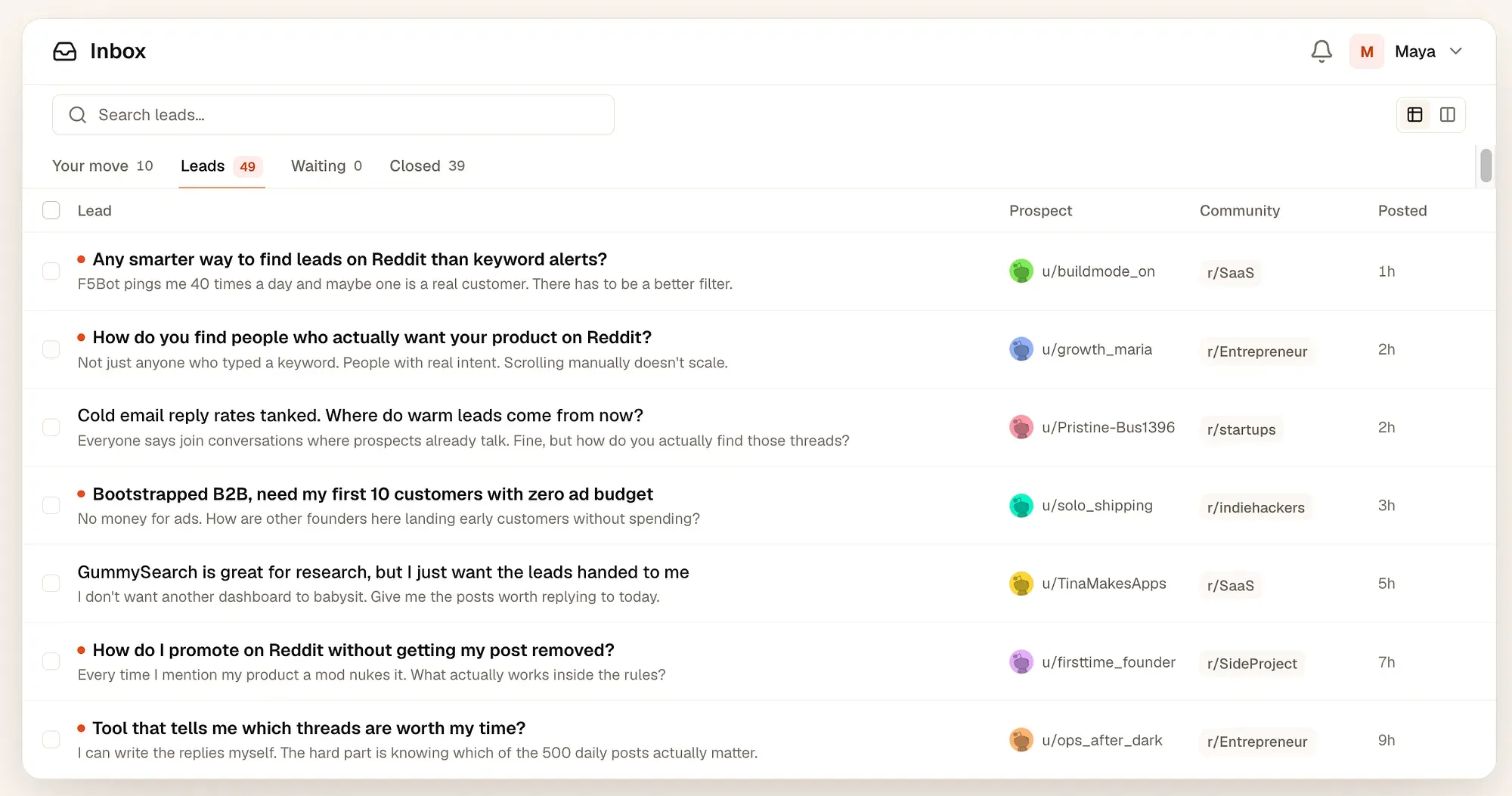
Relevant discussions appear in a single inbox, where the company can review the context and decide whether to join the conversation.
Intoru can also help draft a reply that fits the discussion and follows the rules of the subreddit, while leaving the final response to the user.
The team uses the same process for its own outreach. A Reddit post asking how to find a startup’s first customers, for example, could be matched with Intoru itself and give the founders a natural opportunity to introduce the product.
How Intoru uses Gonka
Every potential match identified by Intoru requires an AI call. The model receives the Reddit post together with information about the campaign — what the company does, which problem its product solves and who its potential buyer is. Gonka handles this classification stage, deciding whether the post describes a relevant problem or is simply noise.
At Intoru’s current scale, this is not a small background feature. According to figures shared by the team in Gonka’s Discord, the workload amounts to approximately 10.03 million requests, 14.16 billion input tokens and 3.66 billion output tokens per month. That volume made the cost of inference a core part of the product’s economics.
“We started with OpenAI and GPT models. At our volume, however, they were too expensive, so we began looking for alternatives. Then I remembered Gonka and thought, ‘Okay, there is Gonka. We can try it,’” Emil recalls.
During its first week with OpenAI, Intoru spent around $40, including approximately $24 on GPT-5 nano alone. According to the team, running its current workload on Gonka would cost roughly $40–50 per month even without free credits.
Price alone, however, was not enough. Intoru first tried GPT-5 nano, the cheapest GPT option available to the team, but its output did not meet their needs. The founders then tested models available through Gonka.
“For us, quality was number one. We used a GPT-5 nano model, and the quality was only so-so. Then we started using Kimi K2.6 and realised that it was good enough for our needs,” Emil says.
Kimi was initially the team’s main model, but available capacity later became a limiting factor. Intoru gradually shifted most of its workload to MiniMax, which now handles roughly 80–90% of its requests, while Kimi remains in use for a smaller set of tasks.
Connecting to Gonka was relatively straightforward. Running millions of requests reliably was the harder part.
“The integration itself was not very difficult. The hardest part was understanding the capacity constraints and related issues,” Emil explains.
Intoru now distributes traffic across four Gonka brokers. Its own routing system adjusts the load assigned to each one, reduces traffic after timeouts or rate limits, and activates additional capacity when the request queue begins to grow. If a provider stops responding, it is temporarily removed from rotation and checked again later.
If all four Gonka providers are unavailable, the system falls back to OpenRouter, where it can access the same MiniMax and Kimi models at a higher cost.
“It is our emergency red button: if none of the Gonka providers responds to our requests, we use OpenRouter,” Emil says.
What comes next
Intoru is still at an early stage. The team hopes to reach its first 100 paying customers within about three months. For now, the founders are focused on improving the product and understanding which features users find most valuable.
If Intoru grows, the team plans to expand beyond Reddit posts. The next steps could include analysing Reddit comments and later adding X, LinkedIn, other forums and social platforms. The goal would remain the same: finding conversations where people describe problems that a company may be able to solve.
For Gonka, Intoru is already a real production use case. The network helps the team keep AI costs low enough to process a large number of requests, although capacity and reliability remain challenges.
“There are some capacity problems because it is still very new, but I see a bright future. If the community keeps growing and Gonka adds more open-source models, it could become very useful for many types of businesses,” Emil says.
If your team uses Gonka for AI inference and would like to share your experience, introduce your project in the #community-projects channel on Gonka’s Discord server. We may feature your story in a future article.
Your support helps keep the blog independent
It helps us spend more time on analysis and original stories about the network.