Could Gonka become what OpenAI was originally supposed to be?
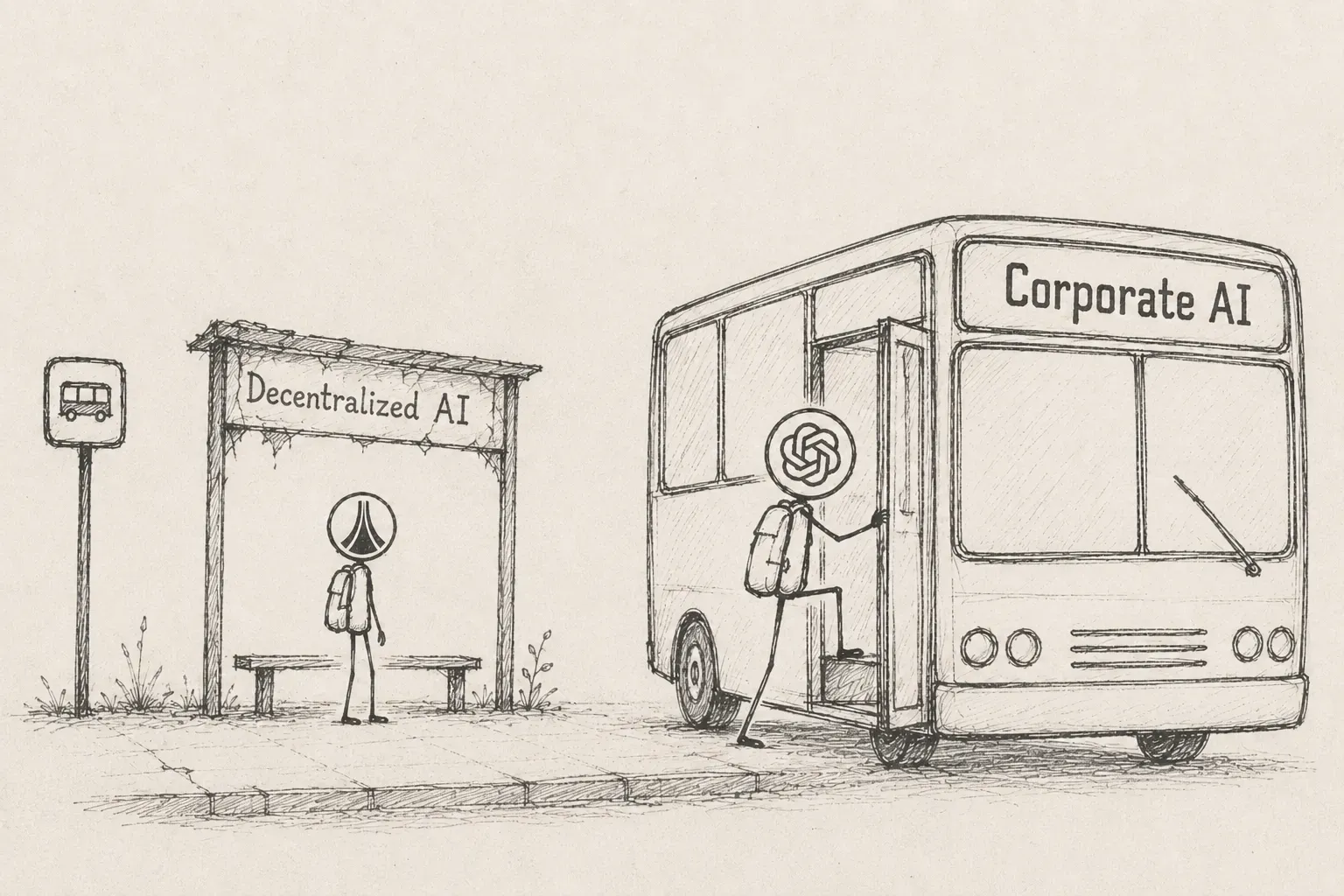
At the moment this essay is being written, Gonka is still a relatively small and early-stage project built around an unusually ambitious idea: creating a globally distributed AI infrastructure capable of operating outside the control of any single corporation or hyperscaler.
So far, the network consists of several thousand GPUs operated by independent miners, pools, and data centers spread across different parts of the world — including infrastructure roughly equivalent to nearly 4,000 Nvidia H100-class GPUs.
That still likely represents well under 1% of the compute now being assembled by the largest AI hyperscalers. On the other hand, it is already more AI infrastructure than most sovereign countries on Earth possess.
And yet, this may be precisely the right moment to examine a project like this — because ambitious technological systems are often easiest to understand before scale, capital, and competition begin reshaping their original logic.
OpenAI as a counterweight
When Elon Musk was still viewed primarily as one of the great technological visionaries of his era, he was involved in dozens of ambitious projects. This was before politics and his increasingly polarizing public persona began reshaping much of his public image. Among all those projects, one of the strangest was a small non-profit laboratory with an oddly direct name: OpenAI.
The structure of the organization looked completely alien compared to the kinds of companies Musk usually built. It was nothing like Tesla or SpaceX.
There was also a strange ambiguity around Musk’s own role in the project and the extent of his actual involvement. OpenAI did not look like a normal Silicon Valley startup, because in many ways it was not supposed to be one.
Musk later explained that the original idea behind OpenAI was to prevent advanced artificial intelligence from becoming concentrated in the hands of a single corporation or centralized power structure.
Supposedly, that was exactly why early OpenAI ended up with such an unusual architecture:
- a non-profit structure instead of a conventional venture-backed company;
- no traditional shareholder logic at its core;
- a strong ideological emphasis on openness and collaboration;
- and a public mission framed less around dominance than around preventing dominance itself.
In a strange way, the structure reflected Musk’s own fears about artificial intelligence. At the time, he seemed genuinely convinced that AI could eventually become one of the greatest existential threats humanity had ever faced — potentially more dangerous than nuclear weapons, pandemics, or conventional warfare.
And in his view, there was already one clear hegemon emerging in the field. That hegemon was Google, particularly through DeepMind.
The rise of a new giant over the old guard
Seven years after its founding, the mysterious laboratory finally detonated in public.
In November 2022, OpenAI released ChatGPT, a consumer-facing interface built on top of the GPT-3.5 model family. To people outside the industry it looked almost magical. To people inside the industry, it looked dangerous.
For the first time, advanced AI was no longer confined to research papers, developer demos, or internal corporate tools. Millions of ordinary users suddenly experienced a system capable of writing, reasoning, explaining, coding, and improvising in ways that felt qualitatively different from the generation of AI products that came before it.
It was one of those rare moments when the entire technological landscape suddenly split into “before” and “after.”
And for the first time in many years, the balance of power inside Silicon Valley itself appeared unstable. Google’s stock briefly declined. Executives reportedly declared internal “code red” alerts. The press began openly discussing the possibility that the next dominant AI platform might emerge outside Google’s ecosystem altogether.
The hegemon had suddenly found itself in the unfamiliar position of a pursuer.
Ironically, Musk himself had left OpenAI four years earlier, in 2018. Officially, the explanation was a conflict of interest: Tesla was already aggressively recruiting AI talent from the very same pool of engineers and researchers OpenAI depended on.
Another interpretation is that he may already have concluded the original non-profit structure was too slow and too constrained to compete seriously with Google. OpenAI was not necessarily designed to defeat Google in a conventional corporate sense. But it was clearly built with the ambition to disrupt what already looked like an emerging monopoly on advanced AI research.
And to some extent, that plan actually worked.
Several kings competing for the AGI crown
At first glance, it may appear that the original fear behind OpenAI has already been neutralized through the emergence of competition itself. The world no longer revolves around a single AI laboratory. Several powerful actors are now competing for what increasingly resembles the same prize: the first truly dominant AGI system.
But the structure of the modern AI race hides a far more dangerous dynamic beneath the surface.
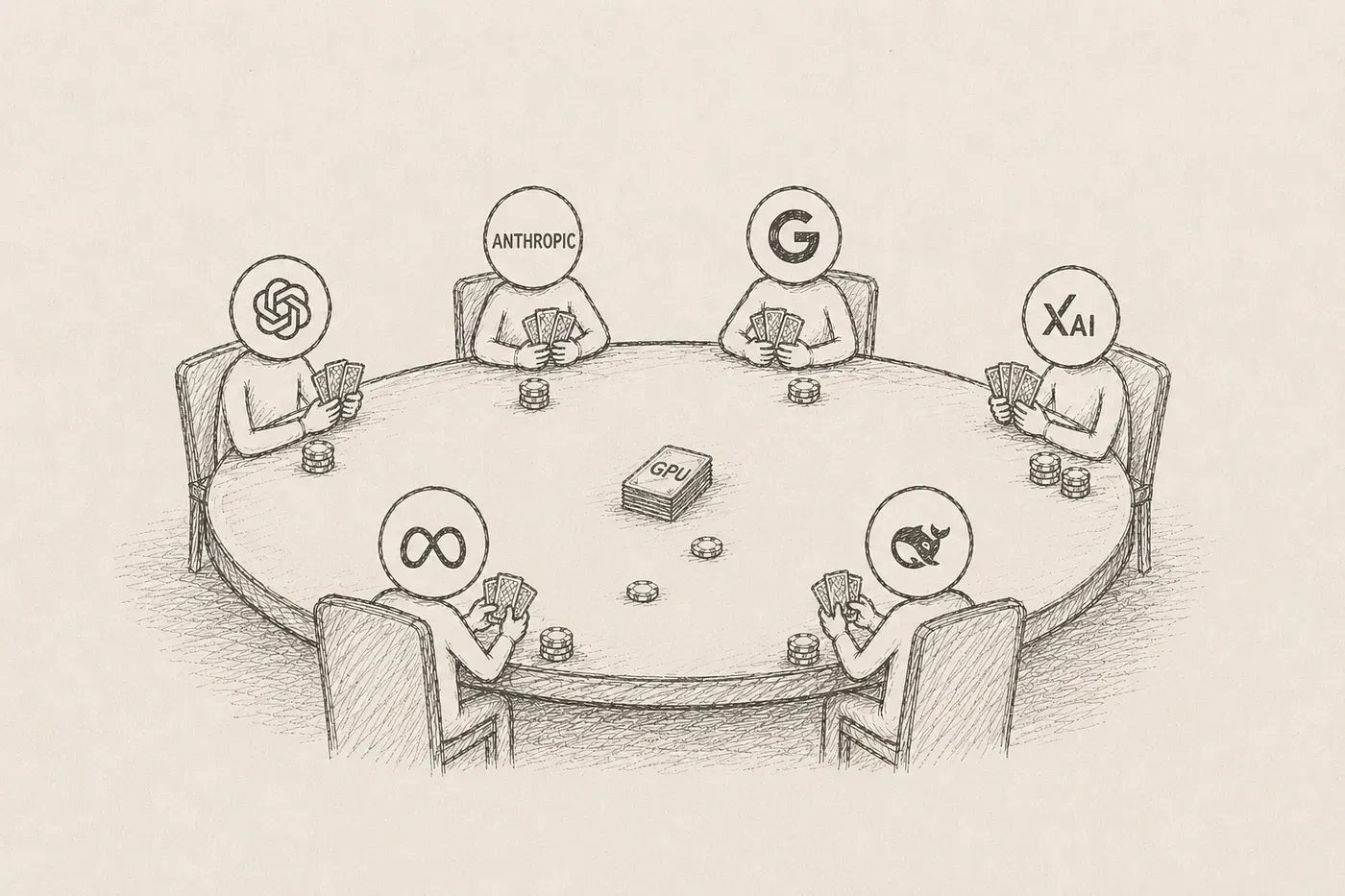
Frontier AI compute is increasingly concentrated among a very small number of players (fittingly, the open-weight players appear to be the ones showing their cards).
Advanced AI is no longer constrained primarily by ideas. It is constrained by compute — by access to the massive GPU infrastructure required to train and operate frontier-scale models.
A company with significantly more compute does not merely gain a better model. It gains the ability to iterate faster, attract more researchers, generate more capital, control more infrastructure, and accelerate even further ahead.
The most advanced AI chips on Earth are produced through an extraordinarily narrow bottleneck involving Nvidia, TSMC, and only a handful of suppliers responsible for advanced packaging and high-bandwidth memory. By 2025, Nvidia revealed that four hyperscalers alone had already ordered roughly 3.6 million Blackwell GPUs — a figure that reportedly did not even include Meta.
The race was beginning to resemble not a software market, but an industrial arms race centered around control over the infrastructure of intelligence itself.
And perhaps that is exactly why the world may still need something resembling the original philosophical ambition behind OpenAI: not merely another powerful AI company, but a genuinely decentralized intelligence infrastructure that cannot be easily monopolized by any corporation, government, or technological empire.
Don’t miss the best Gonka stories
Just decentralize it — so where does Bitcoin fit in?
To discuss how one might even begin solving a problem as structurally difficult as decentralizing AI infrastructure, it becomes necessary to introduce two new characters into this story: brothers Daniel and David Liberman.
What makes the Libermans unusual is that they never seemed interested exclusively in business or engineering. Across different stages of their careers, they appeared consistently drawn toward questions of systems, incentives, and the way technology reshapes societies themselves.
After moving to the United States, the brothers gradually shifted from media and creative work toward technology startups and infrastructure-oriented entrepreneurship. One of their augmented reality companies, Kernel AR, was eventually acquired by Snapchat in a deal reportedly worth around $40 million.
Like many others inside the industry, they became increasingly concerned that sufficiently powerful AI systems could eventually concentrate extraordinary economic and political power inside a very small number of corporations capable of controlling the world’s compute infrastructure.
And that was precisely what led them toward an unusual question. If centralized AI is fundamentally an infrastructure problem, then perhaps the solution must also be infrastructural. Oddly enough, this line of thinking eventually led them not first toward AI itself, but toward Bitcoin.
Not primarily as an investment, but as infrastructure.
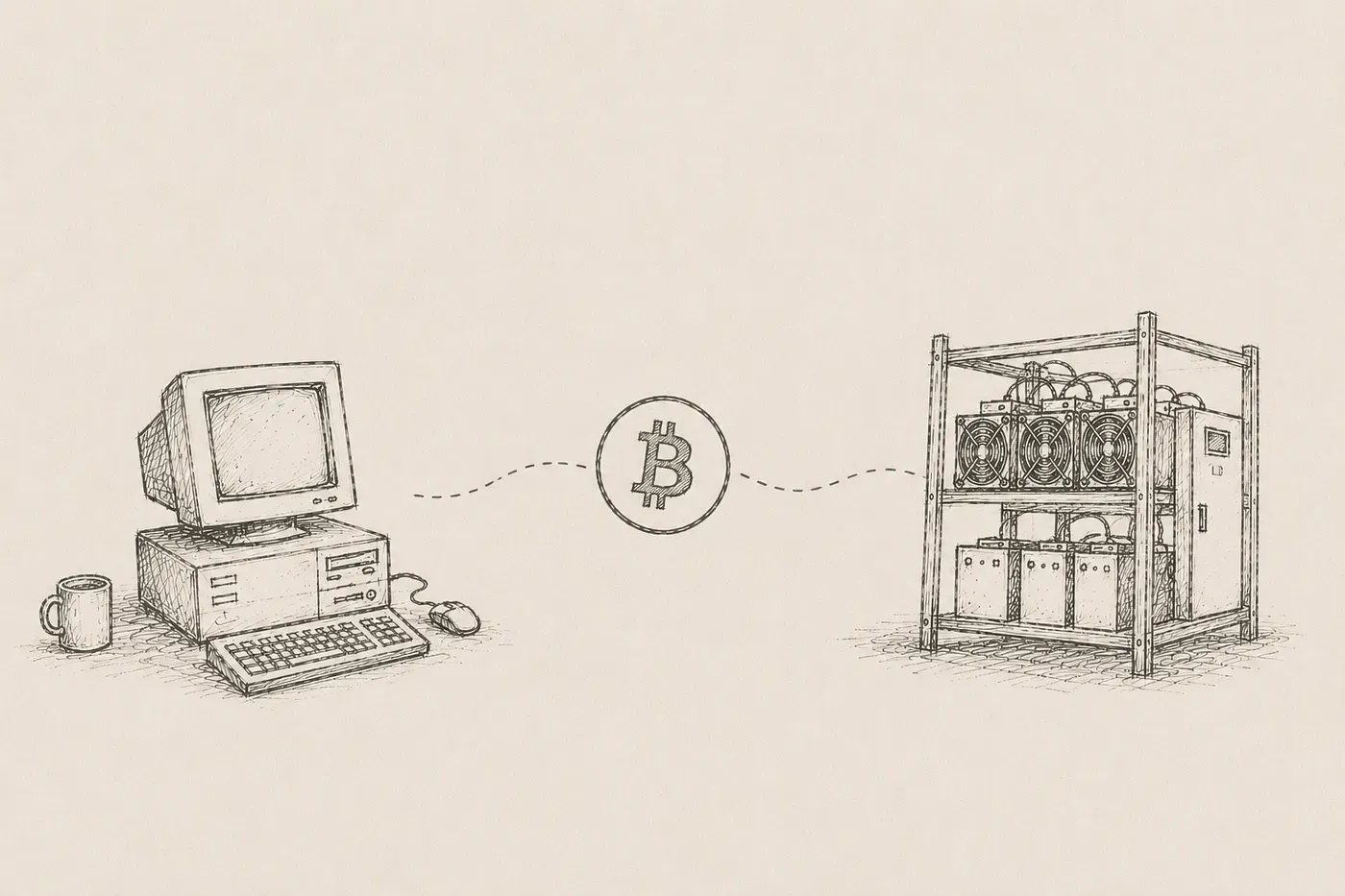
In the early 2010s, Bitcoin was still mined mostly on home computers. By 2026, mining had evolved into an industry requiring specialized industrial-scale hardware.
From this perspective, Bitcoin looked less like a speculative asset and more like one of the largest decentralized hardware coordination systems ever created.
Over the course of its existence, the rise of cryptocurrency mining helped create an enormous global industry built around distributed computational hardware. Economic incentives created by decentralized networks accelerated the industrialization of large-scale compute infrastructure, transforming what had once been a niche hobbyist ecosystem into a massive global sector.
The Libermans began wondering whether a similar mechanism could eventually be used not merely to secure blockchains, but to help bootstrap decentralized AI infrastructure itself.
Eventually, it attracted the attention of Bitfury — one of the oldest major Bitcoin mining companies in the world. The company announced a $50 million commitment to the initiative — a large bet on a project that at the time still looked highly speculative to most outsiders.
What exactly did experienced Bitcoin miners see in this idea that most people still did not?
Gonka as a distributed inference network
Today, following its genesis launch on August 22, 2025, the network already includes surprisingly serious hardware — not only in quantity, but also in quality. Miners are already operating GPUs such as B200s, H200s, and even limited numbers of early B300 clusters distributed across dozens of independent participants.
The experiment itself no longer appears theoretical. Geographically distributed AI inference running on decentralized infrastructure is already happening in practice.
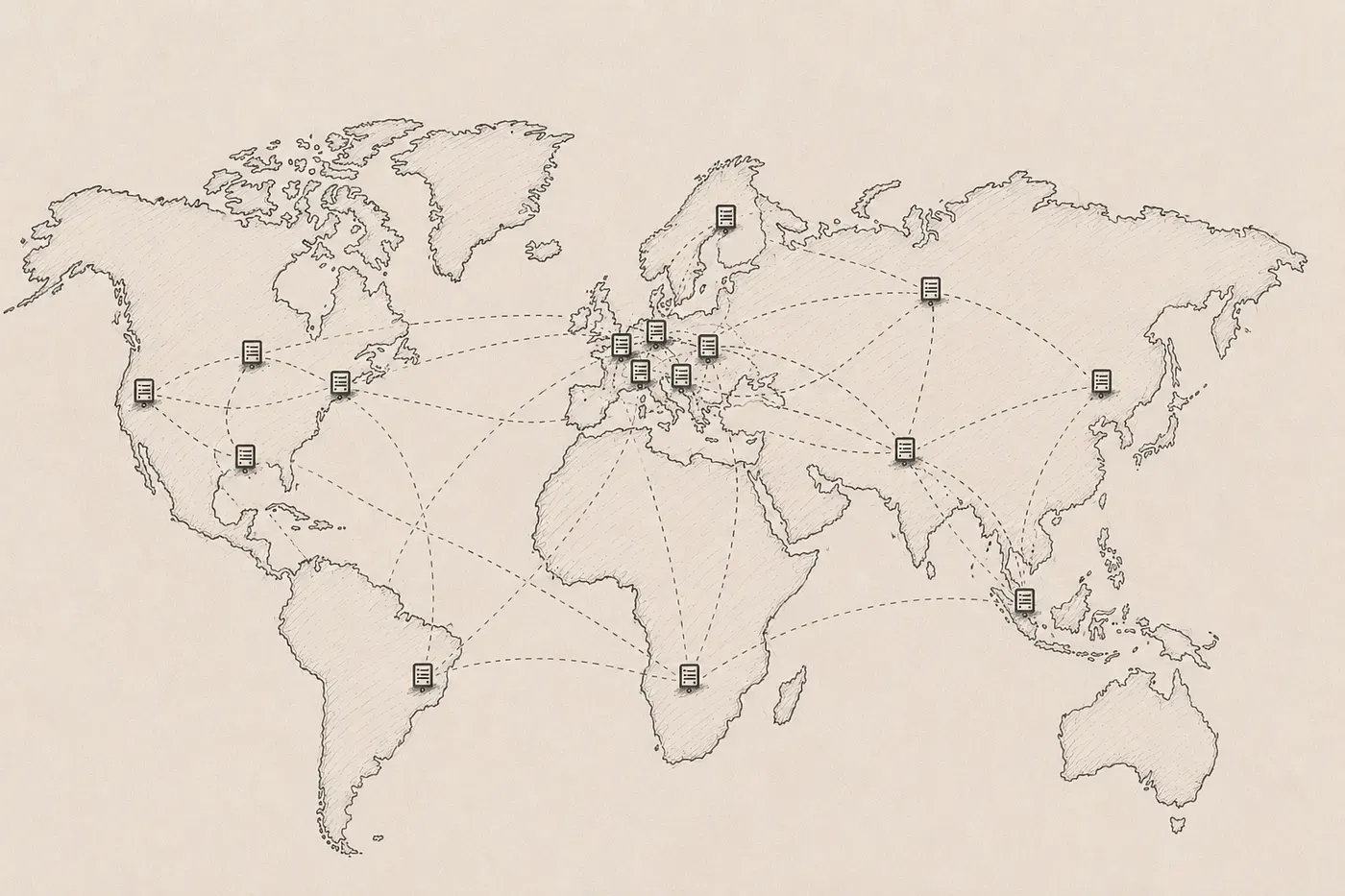
A simplified visualization of the geographically distributed infrastructure currently participating in the Gonka network.
From the beginning, Gonka’s economics borrowed heavily from Bitcoin. The protocol introduced a fixed-supply coin model built around a new form of Proof-of-Work, where computational power could be directed toward meaningful AI workloads rather than wasted purely on hash calculations.
At the next stage, the protocol is supposed to evolve beyond miners themselves. One possible direction is integration with open inference routing systems similar to OpenRouter, where decentralized compute providers could potentially compete through lower inference costs.
Over time, the broader idea is that AI agents, applications, and autonomous software systems would begin purchasing access to decentralized compute directly through the network itself. Open-source ecosystems like OpenClaw may offer a glimpse of how such agent-driven compute markets could eventually emerge.
The architecture of the project also appears designed to create additional economic incentives for the eventual emergence of independent AI ASIC ecosystems capable of competing with today’s leading GPU platforms.
The whitepaper goes even further, outlining mechanisms for decentralized large-scale model training itself — including distributed synchronization, proof-of-learning validation, and collaborative training architectures inspired by systems like DiLoCo.
And underneath all of this lies an even larger ambition: the eventual training of proprietary models within the Gonka network — though for now, that still feels closer to a distant moonshot than an imminent reality.
For now, the system remains extremely early and limited in scale. But the significance of the experiment may already extend far beyond the project itself. It represents one of the first serious attempts to coordinate globally distributed GPU infrastructure through a decentralized network — not merely for mining or speculation, but for the operation of frontier AI systems in the real world.
Why this still may fail
To avoid making the picture sound overly idealistic (although, as members of the community, some degree of optimism is probably inevitable), it is important to acknowledge the weaknesses and unresolved problems that still exist inside the protocol today.
First, Gonka is far from the only project attempting to push the idea of decentralized AI forward. There are already larger, more visible, and in some respects more established players in the space — most notably Bittensor.
And honestly, we do not necessarily see that as a problem. If someone ultimately succeeds in building genuinely decentralized AI infrastructure — even if it is not Gonka — that alone would already represent an important victory.
Still, the particular direction proposed by Gonka feels closer to the kind of infrastructure many of us actually want to see emerge. That is largely why we are here.
At the same time, the protocol itself remains fragile in many ways. Parts of the network are still unstable, inference reliability continues to improve only gradually, and attacks against the system still happen. Open-source models are already running inside the network, but inference quality and consistency remain far from perfect. Questions around privacy and secure data handling also remain unresolved across much of the decentralized AI ecosystem.
It is important to acknowledge this openly. The development team itself remains relatively small, and much of the work is still happening under significant resource constraints.
Second, the project itself is still limited in size. For the broader economic system around the protocol to continue functioning, there ultimately needs to be sustained demand for the token — something that does not always exist consistently, especially under difficult market conditions. For now, much of the system continues operating largely because of miners, contributors, and long-term believers willing to support the project despite its uncertainty.
And finally, there is an even larger structural problem: the current limitations of the open-source AI ecosystem itself.
Many of the strongest open-source models available today come from China. Models such as Kimi K2.6 or Qwen remain open for now, but that situation could change in the future. Outside of a relatively narrow group of frontier open-source systems, the overall market of truly competitive models remains limited.
And in many ways, that is precisely one of the reasons projects like Gonka may need to exist at all: not only to decentralize inference infrastructure, but to help create economic conditions in which a larger open-source AI ecosystem can continue evolving independently.
And yet, despite all the fragility, uncertainty, and obvious risks surrounding a project this early, many of us genuinely believe there is something important happening here.
Today, the entire network still consists of only a relatively small number of independent miners, developers, pools, and believers trying to keep a system alive across different parts of the world. Because beneath all the tokens, protocols, GPUs, and infrastructure debates lies a much simpler idea — perhaps the same idea that once existed at the very beginning of OpenAI itself.
That the future of artificial intelligence may ultimately become too important to remain under the control of a very small number of people — even the most talented and well-intentioned among them.
Your support helps keep the blog independent
It helps us spend more time on analysis and original stories about the network.